

Bangladesh: History, Geography, Language & Music
Bengal was once a thriving hub of people and culture with a rich history spanning millennia. It was filled with daring conquests, magnificent architecture, renowned food, and was the wealthiest region in the world. In 1700, as the richest province of the Mughal Empire, Bengal contributed to 25% of the world’s economy.
I will first explore Bengal’s history before examining its geography, language, music, and demographics. I’ll trace the origins of Bengali music, compare it to modern westernised fusions, and analyse key musical elements such as instrumentation, rhythm, and pitch structures. It will also consider how, when, and where this music is performed.
The Bengal region is now divided between the Indian state of West Bengal and the independent nation of Bangladesh, largely due to British Colonialism and the partition of India. In 1947, after nearly 200 years of British rule, the subcontinent was divided into India and Pakistan along religious lines, with East Pakistan (now Bangladesh) and West Pakistan created as Muslim-majority regions. This process sparked widespread conflict, displacement, and the extraction of significant wealth by the British Empire.
The following section provides a more detailed analysis of how this historical timeline unfolded.
History of Bengal
The first evidence of settlement in Bengal dates back around 4000 years to Pandu Rajar Dhibi. These Bronze Age farmers lived in well-planned towns, worshipped a mother goddess and wore cotton clothing. By around 500 BCE, iron tools allowed them to clear forests and expand agriculture, leading to the growth of large cities such as Pandranagar, Chandraketugarth, and Wari-Bateshwar.
Wari-Bateshwar became a wealthy trading port city, with fortifications, canals, paved streets, textile production, and glass industries, connected to South-east Asia, China and the Mediterranean. Coins found there depict boats, highlighting its maritime trade.
Terracotta art provides insight into daily life during this period. Early Bengalis spoke languages from the Dravidian, Tibeto-Burman, and Austroasiatic families. Around the 5th Century BCE, Vedic-Aryan peoples migrated into Bengal, bringing horses, wheat and the Sanskrit language, the holy language of Hinduism. Through them, Hinduism, Jainism and Buddhism spread into Bengal.
Early relations between Aryans and local Bengalis were often conflictual. The Mahabharata (a series of early Hindu stories), describes Aryan raids taking away Bengal’s wealth. Cultural integration occurred as communities settled and farmed together, rapidly spreading Hinduism and Buddhism. The Bengali language eventually evolved from Sanskrit, while older language groups are still spoken in southeastern Bangladesh today.
Ancient Bengal was highly prosperous. The port city of Tamralipta traded with regions as distant as Crete, Egypt, Southeast Asia, and China. In 409 BCE, a Chinese monk counted over 20 Buddhist monasteries in the city. Gems, spices and fine muslin textiles became famous trading items. Muslin was so delicate that it was nearly transparent. There are records of ancient Romans complaining that these textiles were so fine that the people wearing them might as well be wearing nothing at all. Bengalis called these Muslins flowing water because they were so delicately made.
Bengali traders were active across the Indian Ocean and may have contributed to the spread of Buddhism to Sri Lanka, where it is still the predominant religion. Alexander of Macedon failed to conquer Bengal in 327 BCE, and the region was later incorporated into major empires like the Maurya Empire and the Gupta Empire, both ruled from Pataliputra.
Following their decline, Bengal was divided and fragmented in the 8th century. In response to prolonged instability and repeated invasions, they introduced a new form of election.
The following is an inscription that describes the event:
“Matsyanyayam Apakitum Prakritibhir Lakshmiya Karam Grahitah Sri Goal Iti Kshitisa-sirsam Chudamani-Tatsubha”
“Prakriti” means “The People” in Sanskrit. So the people chose a man of humble origins, the warrior Gopala, as their first king in 750 A.D. Soon, Gopala and the Palas made “the Pala empire,” which would become a major regional power.
Arab accounts describe the Pala army as vast, reportedly including tens of thousands of elephants. The Palas established a stable state with welfare systems, police and hospitals. They were governed by 10 laws, which are as follows:
No Theft
No Murder
No Adultery
No use of harsh words
No Lying
No Defamation
No Talking Nonsense
No Avarice
No bad thoughts
No Attachment to untruth
The Palas supported Buddhist scholarship, ushering in a golden age of Buddhism in Bengal. Bengal was the last stronghold of Buddhism in India, a land where the religion was dying. They used their vast wealth to patronise major institutions such as Nalanda University in Bihar, which reached its peak during their rule. It is one of the oldest universities in the world, outdating Oxford by 500 years. This massive centre of learning educated thousands of Buddhist monks. One section of its library was 9 stories tall, housing hundreds of thousands of books.
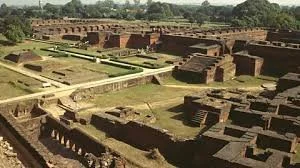
Beautiful brick work, geometry, carvings, hundreds of rooms for students surrounding the monasteries and a central tower soaring out from the flat Bengal plain can be seen at the ruins of this building. Imagine what it would have looked like in its prime!
Unhappy with simply funding existing learning centres, the Palas built a network of universities, including Vikramashila, Odantapuri, Jagaddala and the jewel of them all, Somapura.
Tens of thousands of students and professors came from India, Tibet, China, Java, Cambodia and Myanmar to study logic, philosophy, science, astronomy and buddhism here. The Bengali monk Atisa trained at Vikranshila, then travelled to Tibet and revived Buddhism there, where it’s still the major religion today. Hindus were still a part of Pala society and held important government positions.
Islam entered Bengal through trade from the 8th century. By the 12th century, after 450 years of rule, the Pala kingdom had crumbled after countless invasions. From the chaos, the Senas from Southern India took over Bengal. The Senas were orthodox Hindus, and under their rule, Buddhism went into a steep decline. The Senas oversaw a great age of Hindu literature and black stone art, although interrupted when a new power arrived from the west.
From the 12th-13th centuries, Turkic, Afghan and Iranian Islamic forces established the Delhi Sultanate in Northern India. It’s general Muhammad Bakhtiar swept across Bihar with his army and plundered its rich monasteries, massacred the monks there and left them in crumbling ruins. This historical infamy was sealed as thousands of ancient texts were burned in the aftermath of this atrocity. The surviving monks grabbed what they could and fled to Tibet and Nepal. Bengal fell to the Delhi Sultanate without much of a fight, and the 80-year-old Sena king Lakshmansen fled east.
This marked a turning point in the region’s history, as Bengal was incorporated into a muslim kingdom with Persian and Arabic becoming administrative languages. The Delhi Sultanate swallowed Bengal, and its riches flowed to Delhi. Bakhtiar was murdered while trying to invade Tibet.
In 1342, Shamsuddin Illyas Shah, a Delhi Sultanate official, rebelled and conquered Gaur. He declared independence, establishing the independent Bengal Sultanate. The Ilyas Shah Dynasty ruled for nearly 150 years and created the first unified Bengali identity. Before, Sanskrit, Arabic and Farsi were the state languages, but now Bengali had been standardised and given state support. In the 15th century, a Chinese visitor noted that the universal language in use was Bengali, and the Sultans, although muslim took part in pre-Islamic Bengali traditions such as ceremonial bathing in the Ganges and called themselves rajas (Kings). Bengal was historically divided into several independent territories, including Vaanga, (south), Gaur or Gauda (west/north), Samatana (east), Rarh (west), and Pundravardhana (north), before being unified under the name "Bangalah".
The Bengal sultanate became a major trading power across Afro-Eurasia, exporting silk, muslin, steel and gunpowder. Routes went from Spain to East Africa to China. From the 7th to the 16th Century, Gaur was the capital of Bengal. It was founded by the Bengali king Shasanka in the 7th century, whose reign is the beginning of the Bengali calendar.
By the 16th Century, Gaur was the 5th largest city on earth. Chinese and Portuguese visitors describe the splendour of Gaur’s houses, palaces, ponds and gardens with beautiful coloured tiles which you can still barely see on its ruins today. Its large walls had fabulous gates, its buildings mounted with golden domes, with hundreds of markets and paved streets, where soldiers marched in columns with colourful flags.
The river that Gaur relied on, changed course in the 17th century. This brought floods and Malaria and destroyed its river trade. This once great city died and was abandoned. Its ruins stand today as a reminder of its glorious past.
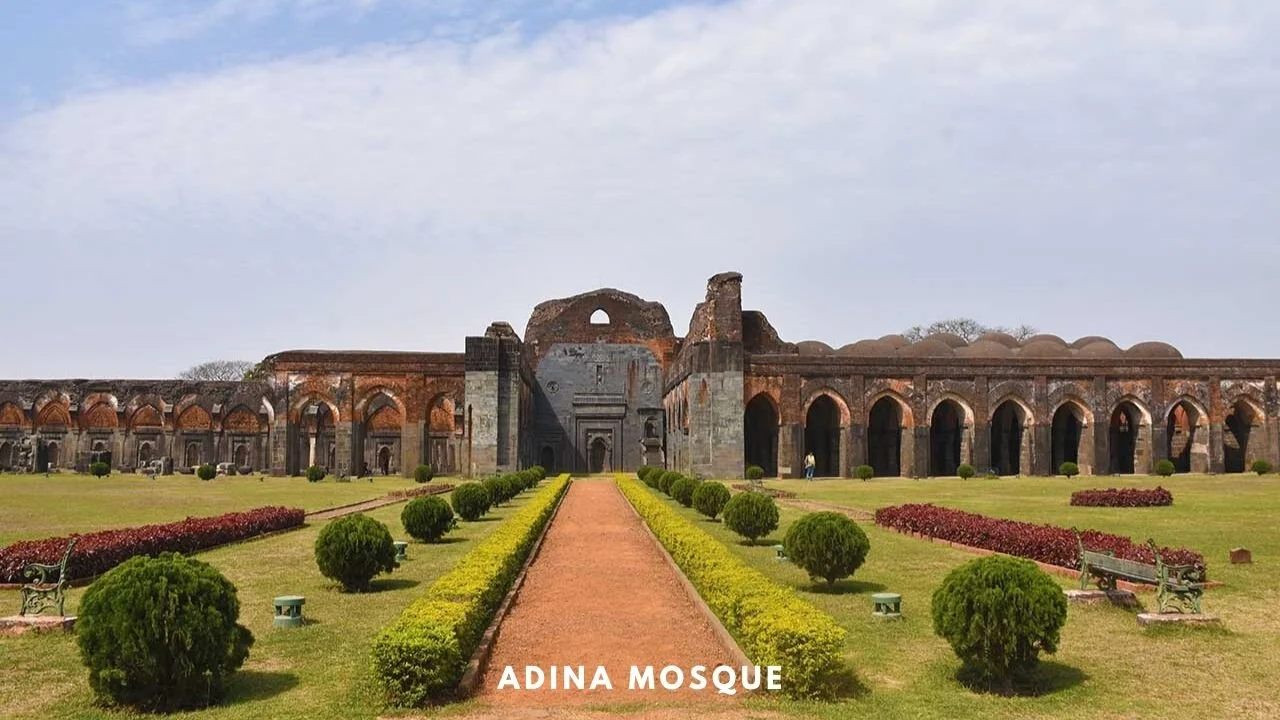
This is the Adina Mosque, built in 1369 by Sultan Sikander Shah during the Bengal Sultanate. This structure is to date the largest Mosque ever built in South Asia. Sikander fought off an invasion from the Delhi Sultanate, and as revenge, he built an authentic Bengali styled mosque using ideas from Iran, The Palas and the Senas, ignoring all other North Indian styles.
Benagli Sultans oversaw a period of wealth and extravagance, which sponsored arts where Hindus and Muslims mixed freely with each other.
Dynasties of diverse ethnic origins have sat on the Bengali throne. At one point, Ethiopian palace guards staged a coup, and an Ethiopian Dynasty ruled Bengal for seven years. Eventually, the Persianised Mughal Empire conquered Bengal in 1576, following decades of immense bloodshed from Bengali resistance. Mughal rule ended Bengal’s independence and integrated it with one of the largest empires in history.
The Mughals also oversaw the Islamification of Bengal. Although Islam had arrived with Muhammad Baktiar and muslims had ruled Bengal for centuries, the Mughals didn’t force religion on the population. By the end of the Bengali Sultanate, Western Bengal was experiencing a golden age with Hinduism, but Eastern Bengal retained Buddhism, Islam, and other indigenous faiths.
Under Mughal rule, officials sought to increase tax revenue by expanding farmland. Western Bengal was already heavily settled, but Eastern Bengal was isolated, forested, and difficult to traverse. In the 16th Century, the Ganges shifted its channel eastward, opening up Eastern Bengal for settlement.
Mughal officials issued permits for people to clear forests, swamps, and marshes to create farmland and build towns. The majority of these people were Sunni Muslim preachers called Pirs.
They founded towns with mosques as their cultural centres, attracting local populations from the forests. As towns began to grow, Islam became closely associated with urban life and economic growth. The Pirs also blended Islamic teachings with local beliefs, shaping the region’s religious and cultural identity.
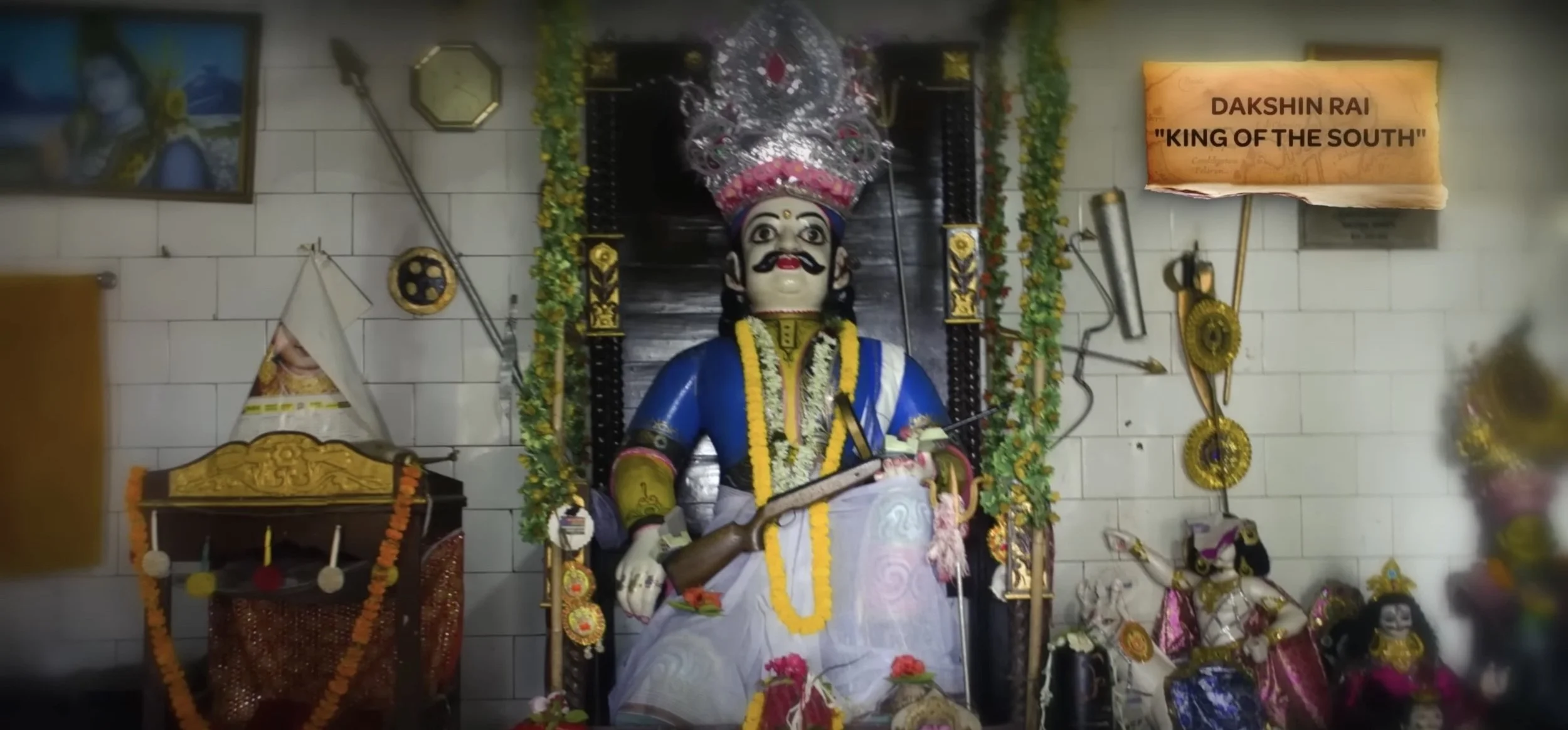
This is a local diety called Dakshin Rai or “King of the South” located in the Sundarbans. This is an example of a combination of a Muslim saint who is also a Hindu god.
Overtime, Hinduism, Buddhism and indigenous religions folded into one Islamic core. Today, most of the people born here are Muslim.
In 1700, the Mughal Empire made up 25% of the world's economy, and Bengal was its richest province. In Other words, Bengal was the richest area of the richest country in the world. Mughal ruler Aurangzeb called Bengal the “Paradise of all Nations.”
Wealth poured into the capital of Dhaka. In 1700, the city had a population of 1 million. Bengalis enjoyed some of the highest living standards in the world. Mughal Bengal was home to the largest textile manufacturing and shipbuilding industries globally. Ottoman and British navies sailed in Bengali ships. Canons and guns relied on Bengali gunpowder, and armies fought with Bengali-made steel.
In the 1760s, British shipbuilders abandoned their easily broken and flooded forecastles and poop decks and adopted a stronger, watertight flush deck, a design inspired by Bengali rice ships. Bengal’s rice fed Sri Lanka and the Maldives. Nobles of Europe, the Middle East and East Asia wore the finest Bengali silks and Muslins and enjoyed tea and candy sweetened by Bengali sugar. Muslins of this era were so well made, that 20 meters of this material could fit into a small tobacco box.
Indian, Greek, Roman, Arab, Ethiopian and Chinese sources show that Bengal imported immense amounts of textiles as early as the 3rd Century BCE. Bengalis outproduced the world through their intricate export and production system. Rivers and canals acted as highways connecting rural farmers with specialized production towns, and then to urban markets and ports. Some towns focused on textiles, others on sugar processing, others on cash crops, or shipbuilding.
In Dhaka, state-owned factories or Karkhanas employed thousands under one roof to produce specialized goods for export to Europe, East Africa and China.
As a trade hub, Bengal attracted fortune seekers. The Portuguese were the first Europeans to sail around Africa and into the Indian Ocean in 1498. They soon arrived in Bengal and were awed by it’s wealth. In 1528 the Sultan allowed them to settle in Chittagong. They soon joined Arakan pirates, engaging in piracy and slave trading in the Bay of Bengal. The French, Spanish, Danish, Dutch and British followed in the following decades.
The British East India Company set up a trading post in the small fishing village in Kolkata in 1690, which they called Calcutta. By the early 1700s, Mughal control of Bengal was weak. Bengal was essentially independent, ruled by Princes called Nawabs from the dazzling city of Mushibad, who were among the world's richest rulers.
By the mid 1700s, Portuguese and Arakan pirates caused havoc, and the Marathas (A rapidly growing empire from central India) repeatedly invaded from 1741 onwards. The Marathas killed about 400 thousand people in Bengal. Eventually, the Nawabs started paying 1 billion modern dollars a year to keep the Marathas away.
During the 1700s, the British East India Company demanded increasing concessions from a weakened Bengal, and tensions rose. When the British built illegal fortifications around Kolkata, Nawab Siraj-ud-Duala besieged the city in June 1756 and expelled them. The following year, in 1757, the British and Bengal would meet at the Battle of Palashi.
Siraj had every advantage: a larger, better trained army and superior artillery. But he made a fatal error. He antagonized Bengal’s wealthiest banking families and his army commander, Mir Jafar. Robert Clive, leader of the East India Company, had secretly conspired a deal with Mir Jafar and these families. During the battle, Mir Jafar’s army stood by as British artillery killed about 500 loyal Bengali soldiers. Siraj fled, was later murdered, and Clive installed Mir Jafar on the throne.
The company soon deposed Mir Jafar and made the East India Company one of the wealthiest corporations in history, which paid for the conquest of India.
In 1858, company rule ended, and the British crown took direct control. South Asia was now governed from Kolkata, the second-largest metropolis of the British Empire after London. British rule brought devastation to the “Paradise of Nations.” Robert Clive and the East India Company’s mismanagement caused a famine in 1770 that killed about one in four people. That’s roughly 3 to 10 million people who received no aid. Over the next 127 years, Bengal would suffer from 25 British policy-induced famines.
In 1793, Britain’s Permanent Settlement Law changed Bengal’s land system. Zamindars, tax-collecting nobles under Mughal rule, became landowners with fixed annual payments to the British. Failure to pay meant their land would be sold. This burden fell on the peasants, who lost their land rights. New landowners, mostly Hindu, exploited the peasants, mostly Muslim, raising rents and evicting those who could not pay. The British wanted cash, so peasants were forced to take high-interest loans, trapping families in crushing generational debt.
Bengal’s textile production plummeted from 5.6 million pieces in 1799 to 244,000 in 1859. As Bengal was de-industrialized, millions of workers and artisans were forced back into agriculture to grow cash crops like Indigo, silk, jute and opium, which the British sold to China for tea.
Cheap, Indian raw materials fueled Britain’s Industrial Revolution, while the company forced British goods into India tax-free, destroying Indian industry.
Journalist William Digby noted, “England’s Industrial supremacy owes its origin to the vase hoard of Bengal.
By the 1800s, Dhaka’s spinners and weavers had died in famine. The city was impoverished, ruined and abandoned. The art of making fine Muslins was lost. Life expectancy in South Asia plummeted under British control. Economist Utsa Patnaik calculated that the British drained about $45 Trillion dollars from the Indian subcontinent between 1765 to 1938.
BENGAL RENAISSANCE
Kolkata was now the capital and nerve centre of British rule in the Indian subcontinent. English, Bengali, Sanskrit, Latin, Western & Indian ideas mixed freely. As an economic hub, Kolkata prospered and attracted ambitious Bengalis.
The University of Kolkata opened in 1857, and soon a generation of wealthy and educated (mostly Hindu) Benaglis ushered in an era of literature, art and science called the Bengal Renaissance. During this period, world-class poets and writers emerged from Bengal, including:
Kazi Narul Islam (1899-1976): Known as the Rebel poet and the National poet of Bangladesh, he produced profound poetry with revolutionary themes.
Jagadish Chandra Bose (1858-1937): a biologist, physicist, botanist and science-fiction writer. In November 1985, Bose demonstrated wireless telegraphy at a public demonstration in Kolkata. He shot radio waves through a person over 23 meters and two walls to trigger a bell. This was two years before Guglielmo Marconi (1874-1937) - the famous inventor of radio, performed a similar experiment in England.
Bankim Chandra Chatterjee (1838-1894): A renowned novelist.
Rabindranath Tagore (1861-1941): An iconic poet, writer, playwright, spiritualist, composer, and singer who wrote over 4,000 poems and 2500 songs. He took up painting at 70, producing over 3,000 drawings.
Tagore’s work focused on human dignity, freedom, universalism, nationalism, anti-nationalism, internationalism, anti-imperialism, and religion. His work varies from short beautiful quotes to full on breakdowns of nationalist thoughts. He is a prominent Bengali figure and his work can be found everywhere. Every Bengali has heard of this man. In 1913, he became the first non-European to win a Nobel Prize.
Tagore’s songs, called Rabindra Sangeet, remain hugely popular today. He was a global phenomenon in the early to mid-1900s, meeting with the likes of WB Yeats and Albert Einstein. Tagore reshaped Bengali literature and music, championed indian independance, and promoted mass education. In protest against the British massacre of civilians at Amritsar in 1919, he renounced his knighthood in disgust.
Two of his poems became national anthems.
His poem “Jana Gana Mana” became the national anthem of India, and his other poem “Amar Shonar Bangla” became the national anthem of Bangladesh.
“Jana Gana Mana”
Thou art the ruler of the minds of all people,
Dispenser of India’s destiny.
Thy name rouses the hearts of Punjab, Sindhu,
Gujarat and Maratha,
Of the Dravida and Orissa and Bengal;
It echoes in the hills of the Vindhyas and Himalayas,
mingles in the music of Jamuna and Ganges and is
chanted by the waves of the Indian Sea.
They pray for thy blessings and sing thy praise.
The saving of all people waits in thy hand,
Thou dispenser of India’s destiny.
Victory, victory, victory to thee.
“Amar Sonar Bangla”
My golden Bengal, thee I love
Forever thy skies be,
thine air, my heart
O Mother like a flute set my heart in tune
Golden Bengal thee I love
O mother aroma of mango orchard
In falgun driveth me crazy
Ah, such Miraculousness
O mother aroma of mango orchard
In falgun driveth me crazy
O Mother, Seeth in Ogroayon
All through fields of paddy
Time seeth smiles sweet
Golden Bengal, thee I love ,
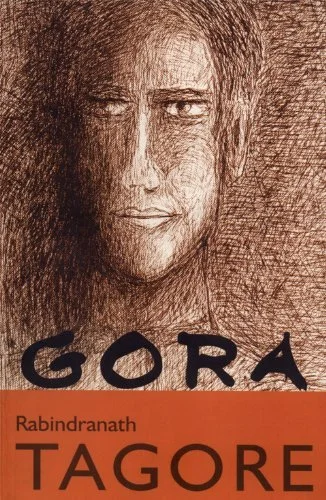
This is Rabindranath Tagore’s novel “Gora”
It’s an incredible insight into Indian politics, feminism and nationalism. It also has a crazy twist about the Irish in it. Highly recommend reading this book.
Independence movement
The Bengal Renaissance brought a new generation that demanded civil rights and fostered nationalist consciousness, which led to several revolts against British rule. Bengal paved way for the Indian Independence movement. The British used a policy of divide and rule, pitting Muslims and Hindus against each other to protect colonial interests, which intensified divisions. This eventually contributed to the emergence of the two-nation theory, proposing separate nations for Hindus and Muslims.
British policies had left Bengali muslims in abject poverty under the dominion of the British authorities, upper-class Hindu Zamindars and money-lenders. In 1929, one East Bengali peasant said, “My father, sir, was born in debt, grew in debt and died in debt. I have inherited my father's debt, and my son will inherit mine.”
The Muslim League, which pushed for the creation of Pakistan, also called for the end of the Zamindari system, highlighting both a class and religious divide. When Hindus pushed for independence, the British tried to fracture the movement by placing more Muslims in government positions. With deteriorating Hindu-Muslim relations, violent communal riots became common, riots previously unknown in pre-British Bengal.
During these riots, poet Kazi Nazrul Islam wrote poems urging Muslims and Hindus to unite. But fear prevailed. Hindu and Muslim communities worried that in a united India, one group would dominate the other. They began to see each other as two monolithic rivals, forgetting their shared homeland, language, heritage, and culture built over nearly a thousand years.
During these riots, poet Kazi Nazrul Islam wrote poems urging Muslims and Hindus to unite. But fear prevailed. Communities worried that in a united India, one group might dominate the other. They began to see each other as monolithic rivals, forgetting their shared homeland, language, heritage, and culture built over nearly a thousand years.
Despite this conflict, both the Muslim League and the Indian National Congress were gaining momentum to push the British out and secure independence.
WW II
Britain declared war on Germany in 1939, dragging its Indian colony into World War II. After Japan attacked Pearl Harbour on December 7th, 1941, they conquered British Malaya, Hong Kong, Singapore, and invaded British Burma by summer 1942, forcing the British army to retreat. Kolkata became the stronghold of British power in the east, but it wasn’t reinforced militarily. The Japanese bombed it without any resistance.
To deny Japan any resources, the British destroyed boats across Bengal and stockpiled rice in Kolkata to feed its citizens. Any rice left in the countryside was destroyed. Prices skyrocketed beyond what the poor could afford. In August 1942, Bengal’s chief minister Fazlul Haque, warned of a rice famine, but he was ignored.
By 1943, the first reports of death began to trickle into Kolkata. This trickle soon became a tsunami. The famine killed one in every seven people. Rural peasants, weakened by months of hunger, fled to Kolkata but received no aid; those caught by authorities were sent to camps to die.
The British refused to declare a famine, despite their famine code requiring vital aid. Most stockpiled rice rotted in warehouses rather than being distributed. Winston Churchill refused food imports, claiming the famine was the fault of the Bengalis. He reportedly said, “The starvation of underfed Bengalis was less serious than that of sturdy Greeks,” and when parliament reminded him, he asked “Why hasn’t Gandhi died yet?”
By December 1943, the famine officially ended, leaving over 3 million dead. Many estimates suggest this number may be low. During WWII, Bengalis suffered more casualties than the US, UK, and France combined, yet their suffering is rarely acknowledged. The Bengal famine of 1943 would be “The final judgment of British rule in India.”
During this time, rebellions and violent riots broke out between Hindus and Muslims. In 1947, under Viceroy Lord Mountbatten, Britain was compelled to relinquish India. The subcontinent was partitioned into Hindu-majority India and Muslim-majority Pakistan, completely ignoring history and community.
At 11:57pm on August 14th, 1947 Pakistan became independent; India followed the next day. Two centuries of colonial rule ended, but 20 Million people found themselves on the “wrong” side of the new borders. Hundreds of thousands died in the ensuing chaos. Bengal was split: Hindu West Bengal joined India, and the Muslim East became part of Pakistan, ending a shared history of thousands of years. A man who had never left Europe drew the borders.
Some Bengali leaders had pushed for an independent, unified Bengal, but this was rejected. Pakistan was born as a bifurcated nation, with West and East Pakistan separated by 1,400 km. West Pakistan dominated the government, bureaucracy, and the army, taking most economic aid despite East Pakistan having a larger population and earning more revenue. Bengal remained oppressed, just under a new colonial-style regime.
Even though the majority of East Pakistan’s population spoke Bengali, the sole official language was Urdu. In February 1948, East Pakistanis went on strike demanding recognition of their language. Governor General Muhammed Ali Jinnah, visited Dhaka on March 19th, and publicly declared, “The state of Pakistan is going to speak Urdu and no other language, and anyone who tries to mislead you is the enemy of Pakistan.”
On February 21, 1952, thousands of students and members of the Bengali language movement protested at Dhaka University. Police opened fire, killing five and injuring hundreds. Bangladesh’s first martyrs had emerged. February 21st is now International Mother Language Day, a deeply important holiday in Bangladesh.
The Awami League political party was formed to push for Bengali rights. East Bengal saw riots, strikes, and growing cultural pride. Tagore’s Bengali songs were sung proudly and became symbols of a new national identity that was forming. Sheikh Mujibur Rahman rose as a political leader and became the Awami League president in January 1966, advocating for East Pakistan’s self-rule. Mujibur and thousands of Awami League members were jailed, and West Pakistan banned all Rabindranath Tagore songs. His arrest made him a political icon for Bengalis.
In November 1970, the deadliest cyclone in recorded history hit East Pakistan, killing about 300,000 people, with no response from West Pakistan. The president, Yahya Khan, released Mujibur and called for elections for 1970. On December 3rd, results came in. The Awami League won decisively: 167 of 169 East Bengal seats in the 313-member National Assembly. Mujibur should have become Prime Minister, but martial law was imposed instead.
On March 7th, 1971, Mujibur made an iconic speech to about 2 million people in Dhaka.
“After this, if they don’t pay our salaries, if another bullet is fired, if any more of our people are murdered, it is my request to you all, turn every house into a fortress, resist the enemy with everything you have. The struggle this time is the struggle of our liberation and freedom. This struggle is the struggle for our independence. Joy Bangla.” (Victory to Bangla).
On March 25th, 1971, Yaya initiated Operation Searchlight. The Pakistani military targeted Bengali leaders, armed units, and terrorised civilians, attempting to crush the idea of Bangladesh and strip away their basic right to speak Bengali. Mujibur was arrested and smuggled to West Pakistan.
Soldiers, tanks, and armoured vehicles attacked Dhaka, burning the city, shelling university dorms and massacring students. Students and lecturers barricaded themselves in Dhaka University and resisted the army’s assault. Tens of thousands of civilians died, and hundreds of thousands were subjected to pillaging, torture, and execution. Total war was unleashed on Bangladesh. Survivors say they couldn’t stay in any village for any length of time. The Pakistani army was burning the villages one after another. Civilians would be lined up and shot for not complying with their demands.
Within two days, the US declared it a mass genocide. A declassified blood telegram sent on April 6th, 1971, signed by 20 diplomats, exposed the atrocities, but turned a blind eye in fear of losing Pakistan as an ally in the Cold War. Guinness recognises this as the worst genocide in the 20th Century. This is the only war in history where civilians fought for their right to speak their mother tongue.
My grandfather, a Lieutenant Colonel, was captured during this period. He escaped and fought as a freedom fighter. fought in the war are known as Mukti Judhas (Freedom Fighters).
By May 1971, 1.5 million Bengalis fled to India, around 60,000 per day. survivors recount: “The suffering and the torture of the people’s mind and body has been unforgettable.” The Awami League regrouped in Kolkata, forming a government-in-exile. The Mukti Bahini recruited thousands to fight a guerrilla campaign. By November 1971, tens of thousands of freedom fighters were actively assaulting Pakistani forces.
In April 1971, Archer Blood, the US counsel in Dhaka, sent a cable message to President Nixon and Henry Kissinger, denouncing US support for Pakistan’s actions, which he called genocide. Nixon and Kissinger were furious at Archer Blood for leaking this information. The Pakistani military relied on American weapons, and Pakistan was a strategic ally for both the US and China, serving as a secret communication channel to Mao Zedong in China. The US prioritized geopolitical goals over humanitarian aid.
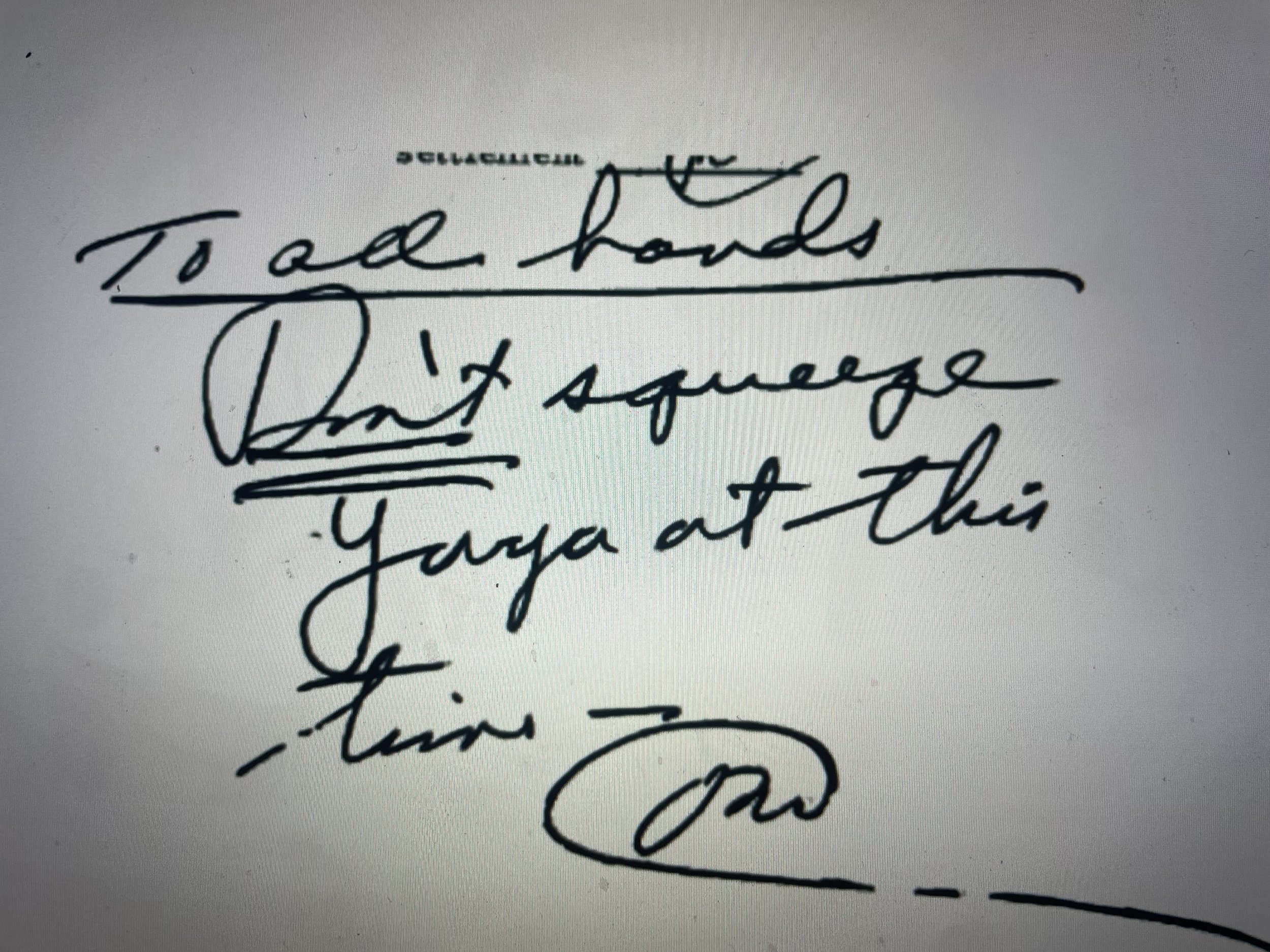
On May 2nd, 1971, with reports of genocide coming in, Nixon and Kissinger told their government “Don’t squeeze Yahya at this time.” The don’t was underlined three times.
India had been supporting Bangladesh for months. Kolkata and West Bengal served as a base of operations for the Mukti Bahini, assisted by the Indian army. India faced a massive humanitarian crisis as millions of refugees fled across the border.
The US warned India’s leader Indira Gandhi that any intervention to stop Pakistan would have severe consequences.
Kissinger informed China that if they intervened militarily to support Pakistan, the US would respond if another nation, like the Soviet Union, countered. In response, the Soviet Union allied with India and, in August 1971, signed a treaty agreeing to defend India if attacked.
A war of liberation by Bengalis, who simply wanted to speak their own language, had escalated into a tense international standoff. At one point, Nixon even discussed “Lobbing nuclear weapons in” to defend Mao Zedong’s China if the soviets intervened on India’s side.
Meanwhile, the Mukti Bahini continued to fight courageously against a better-armed Pakistani military, but the genocide continued, and millions of refugees poured into India. In the words of Kazi Nazrul Islam: “Announce the coming of a great holocaust. All is lost.”
Confident with Soviet support, India was massing troops on the Pakistani border in November 1971. On December 3rd, Pakistani planes bombed strategic sites across Northern India, prompting India to enter the war. The US dispatched a nuclear aircraft carrier and a powerful task force to the Bay of Bengal as a warning. India had to secure total control of Bangladesh and a Pakistani surrender before American forces arrived, or the resulting stalemate would have created a humanitarian disaster
The Indian and Bangladeshi armies advanced rapidly toward Dhaka. The fighting was brutal, but two weeks later on December 16th, 1971, they successfully retook Dhaka. Lieutenant General Amir Abdullah Khan Niazi signed the instrument of surrender and left himself and his troops under the command of Lieutenant General Jagjit Singh Aurora.
This war killed an estimated 1.7 Million people in nine months. Hundreds of thousands of women were sexually assaulted, 10 Million people became refugees in India, and 20 million were displaced internally. Yet, this marked a new beginning, and Bangladesh was born.
Bhutan, India, Nepal, Australia and Germany were among the first Nations to recognise Bangladesh as an independent country. Bangladesh joined the United Nations on September 17th 1974, and in 1975 Bangladesh became the vice-president of the general assembly of the United Nations.
Both Bangladeshi and Bengali are correct terms. Bengal is a region in South Asia, and Bangladesh is a nation within this region. Most inhabitants speak Bengali or Bangla. Bangladesh literally translates to Bangla Country. Bangla Is the language and Desh means country or land.
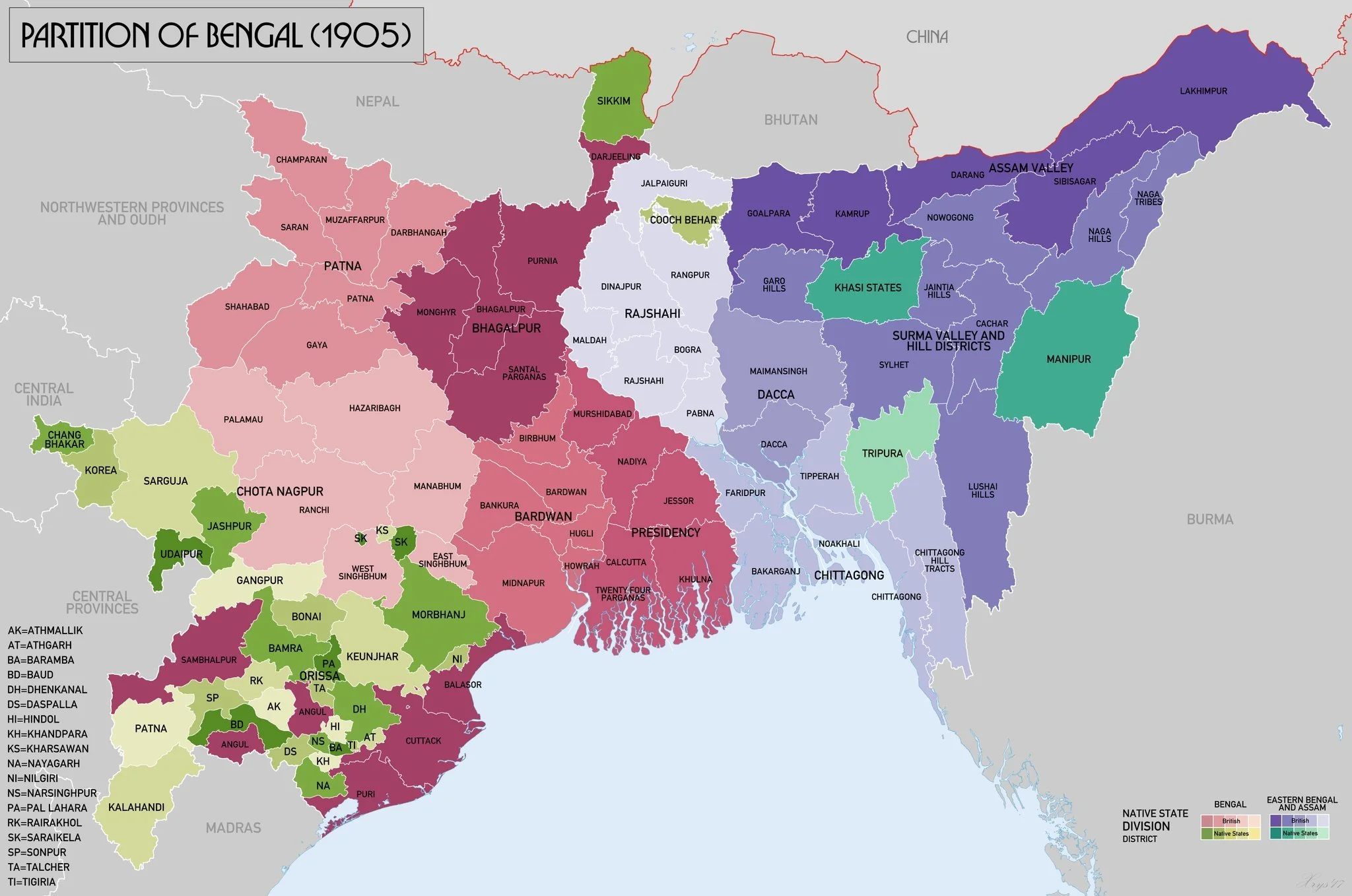
This is a map of what Bengal looked like before the first partition of Bengal in 1905, enforced by the British. Despite being divided by borders since 1905 and 1947, Bengalis still share a common history, food, culture and language that they are immensely proud of and have literally died to protect.
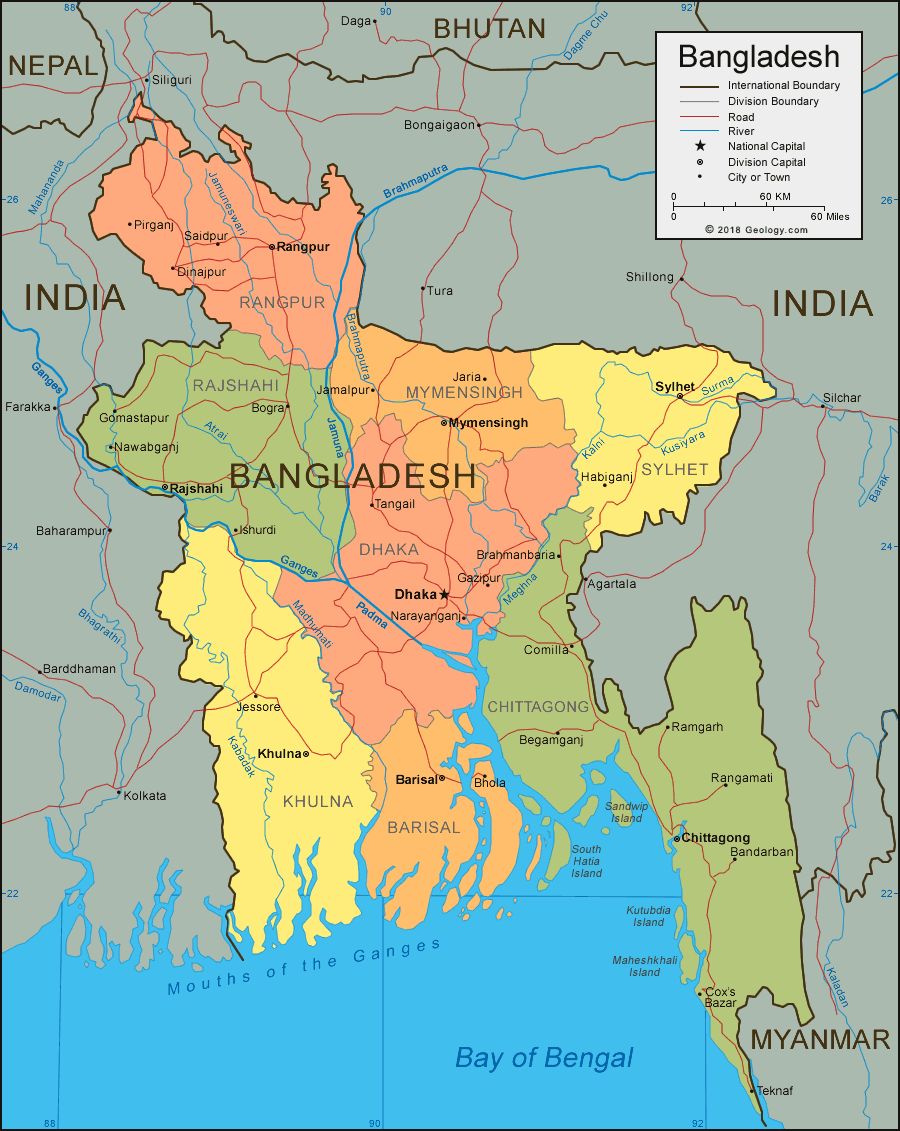
In Comparison, this a current map of Bangladesh’s borders. Much smaller than the previous map before partition in 1905. The rest of the region integrated with India after the British sparked conflict in the region over religion.

This is Bangladesh’s flag. The red on the flag represents the blood of everyone who died whilst fighting for their freedom and the green represents the lush, fertile interior of the land. If you look closely, The red circle is actually not centred. It’s positioned slightly to the left so it appears centred when the flag Is flying in the air. The first version of this flag which was established just after independence in 1971 had a map of Bangladesh within the red circle. However they later removed this as it was too hard to draw.
Bangladesh National Assembly building / Parliament house
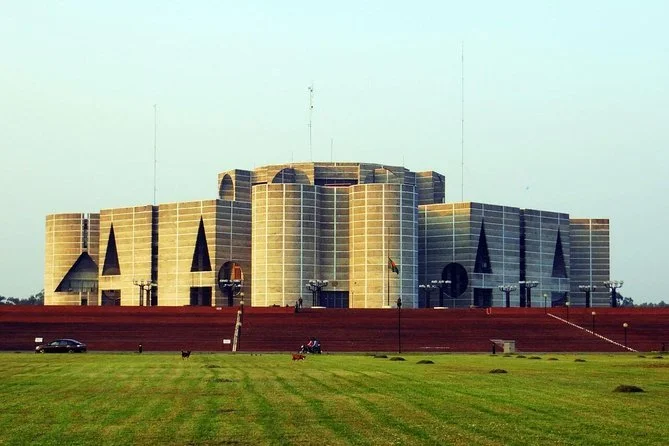
This building is the National Parliament House of Bangladesh, designed by architect Louis Khan. Louis Kahn’s National Assembly Building of Bangladesh in Dhaka is an extraordinary example of modern architecture being transcribed as a part of Bangali vernacular architecture. The National Assembly building, completed in 1982, stands as one of Kahn’s most prominent works, but also as a symbolic monument to the government of Bangladesh.
The National Assembly Building was conceptually conceived in 1959 by the government of Pakistan as an extension to their parliamentary headquarters. It wasn’t until 1962 that Louis Kahn was commissioned to design the governmental headquarters. However, in March of 1971 construction was halted as Bangladesh had declared independence from Pakistan. Originally, Kahn had intended to make a building of monumental presence, but after Bangladesh had officially broke from Pakistani rule in December of 1971 the project became much more of a symbol of democracy and pride for the Bangali people. The building was finally completed in 1982 at more than double the initial estimated cost for completion at $32 million.
Population
There are roughly 300 Million Bengalis worldwide, making them the 3rd largest ethnolinguistic group in the world, just behind Arab (450 Million) & Han Chinese (1.4 Billion). Roughly 283 Million of these people live in Bengal - a small area of about 239 thousand square km (In comparison, just bigger tham the state of Victoria, Australia). About 170 Million of these people are in Bangladesh, and the remainder are in the Indian state of West Bengal. This makes Bangladesh the 8th most populous country in the world.
If the Indian subcontinent were to reunite, the total population would spike up to nearly 2 Billion.
Bangladesh is the 11th most densely populated country on earth, with a total land area of about 150 thousand square km. Every country above Bangladesh is a micro state. There are more people in Bengal than there are people in Russia, Brazil or Mexico, Bangladesh is roughly 86% Sunni Muslim, 12% Hindu & 2% Christian & buddhist.
Religeon
Bengal’s religious history can be found in its landscape in the form of mosques, temples, stupas and churches. About 67% of all Bengalis are Muslim, whilst 32% are Hindus. Buddhists and Christians make up the remaining 1%. Muslims make up 91% of Bangladesh whereas Hindus make up 70% of West Bengal. Hindus may be a minority in Bangladesh but there is still 13 Million of them there, which in comparison is more people than there are in Belgium. In West Bengal there are 24 Million Muslims, which means that they have a larger muslim population there than Syria or Mali.
You can see the religious origins of Bengali people through their surnmes. Kaji, Alif and Mustafi are Muslim names, Bose, Roy and Gupta are Hindu names, Barua is a Buddhist name, whilst Gomez, D’silva and D’sousa are Christian names.
Geography
Bangladesh is located to the east of India, and almost completely surrounded by India including a narrow Silliguri corridor, or the chicken’s neck of India and a small but reasonably sized border with Myanmar in the south-east, and the Bay of Bengal is located in the south.
Bangladesh is split up into two regions. The low lying flat delta on the south of the Ganges river where most of the land is 10 meters or less above sea level and the small hilly plains on the north, north-east and south-east.
Bengal is diverse with the awe-inspiring views of the Himalayas and Darjeeling’s tea plantations in the north, to the lush, rain-soaked region of Sylhet in the north-east. Sylhet gets over 4200 mm of rain each year. Compare this to Seattle, Copenhagen or London all of which get about 1000 mm of rain each year.
The thriving capital of Bangladesh; Dhaka is located in the lower central region right above the Parma river and the Ganges delta, with a population of roughly 24 Million people, making it a mega city which is also one of the most densely populated on Earth. Dhaka is the beating heart of one of the world’s most rapidly developing economies. Old Dhaka - due to its Canals, gardens and Opulence was once called the Venice of the East.
In the South-West of Bengal there is Kolkata, previously known as Calcutta, is the vibrant capital of the Indian state of West Bengal and is home to about 14 Million people. it’s also the Indian city with the most Nobel prize winners.
Further south is the Sundarbans, a biodiversity hotspot and the world’s largest mangrove forest. This is a lush mosaic of rivers, trees and swamps, and one of the last places where you can find the endangered species of the Royal Bengal Tiger, which is also the National animal of Bangladesh. Surprisingly, these Tigers eat about 20 people a year! In the past, some fisherman wore masks in the backs of their heads to scare off these tigers, but apparently the tigers have figured out that trick.
There’s about 2500 Royal Bengal Tigers left. Over the past 30 years, the world’s tiger population has declined by about 50 percent, with about 4000 living tigers left in the world. There’s also many villages buried underneath mango, coconut and jackfruit trees.
South-east Bengal is home to Chottogram, one of Asia’s busiest ports, and Cox’s Bazar, the longest natural & uninterrupted sea beach in the world located in the divisional hub of Chittagong. The beach goes on for 75 miles, although the north part is a huge ship graveyard where companies from all over the world like to dispose their old ships. Civilians then break apart and sell the pieces to make a profit. This area is known for shipbuilding and fishing.
The rugged Chottogram Hills track along the south eastern border with Myanmar and India is culturally unique. Whilst Bangladesh is about 98% Bengali, here in the hills, there are many non-Bengali indigenous peoples and languages, and it’s one of the last strong-holds of Buddhism in South Asia.
Bengal has one of the world’s largest network of rivers. From space, you can see the Ganges, Padma, Brahmaputra Meghna rivers winding down from the Himalayas, building up speed before surging out into the Ganges delta - the largest delta on earth, bringing fertile silk and soil with the waters every year. Bangladesh is especially known for growing Jute, which is the material they use to make ropes.
Bangladesh has more trans-boundary rivers than anywhere else in the world (Roughly 60). Bangladesh shares rivers with both India and Myanmar, and has about 700 main rivers altogether, the largest ones being the Padma, or the Ganges, and the Jamuna or the Brahmaputra.
There are 6 seasons in Bangladesh. They are: Summer (Grisma ritu), Rainy (Barsa ritu), Autumn (Sarat ritu), Late Autumn (Hemanta ritu), Winter (Shitt ritu) and Spring (Basant ritu). Some seasons may extend more than 2 months, while others may be less than 2 months. Each year from June to October, the monsoon season brings in immense amounts of rain. This causes a lot of the southern parts of the land (which are about 10m above sea-level), to start flooding. Throughout history communities have moved as the deltas and rivers have moved.
In 1970, the deadliest cyclone in human history devastated Bangladesh, killing about 300 Thousand people. But these grey skies and rushing rivers have given Bengal some of the world’s most fertile lands which feeds millions of people, and stood as witnesses to the rise and fall of civilisations.
On an average day in Bangladesh, it is typically really hot and humid, which means you’ll probably get really sweaty from the sun. This is because the nation is located in a subtropic region. It’s especially hot during summer, and as time goes on and people continue to completely disregard the well-being of their environment, the climate is bound to get worse.
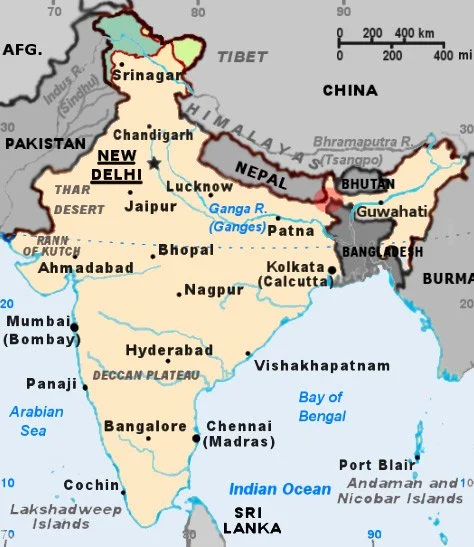
You can see the Chicken’s Neck in this map.

Above is a picture of me riding a horse in Cox’s Bazar, Chittagong when I went to visit Bangladesh earlier this year. I know, it’s crazy! Never in a million years would I have thought I’d ride a horse at a beach!
I’m about to go Para-sailing in Cox’s Bazar in the video above.
I’m about to land in this video.
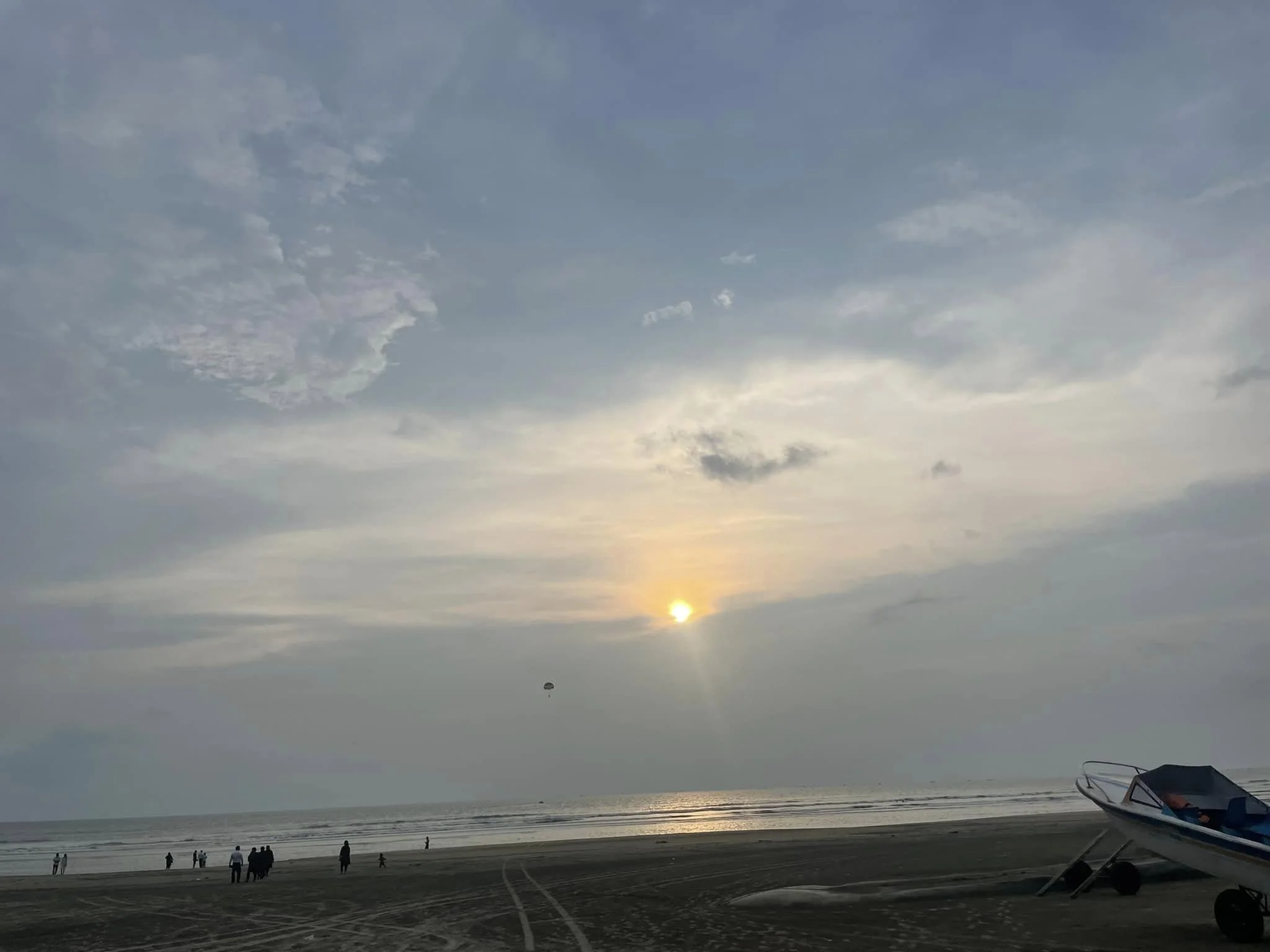
Above is a sunset in Cox’s Bazar, Bangladesh.
LANGUAGE
What we call Bengali in English is called Bangla by its speakers. This is where the word Bungalow comes from, which literally means “Bengali styled house.”
Bengali is the seventh most spoken language in the world, spoken by about 300 Million people worldwide, with over 282 Million native speakers, 172 Million of whom are in Bangladesh and 102 Million in West Bengal. Bengali is the second most spoken language in India, and is an offical language of Bangladesh, India and Sierra Leone (In December 2002, Sierra Leone accepted Bengali as an offical language due to Bangladesh’s peacekeeping efforts in the UN).
Bengali is an Indo-European language, meaning that it shares a common origin with English, Sanskrit, Greek, Latin, Persian and Irish. Although it's a lot closer to other Indo-Aryan languages spoken in the region, such as Hindi, and even more so to languages such as Assamese.
Interestingly, Bengali has no gendered pronouns. “Sheh” can mean He, or She. Bengali is written in its own script called Bengali-Assamese script. Assamese is Bengali’s sister language and they sound very close to each other. I understand Bengali but not Assamese. Whilst listening to Assamese for the first time, I couldn’t understand a word but I found it to be very similar. Bengali & Assamese are both written left to write, and unlike English which floats above an imaginary base line, Bengali words hang down from a line called a Matra.
Bengalis are deeply in love with their language, and many have died for it. 21st of February is International Mother Language day, dedicated to the Martyrs that have died for the Bengali language.
“Tumi Kamon Acho” is how you ask someone how they are doing in Bengali, and “Dhonyobadh” is how you say Thank you.
We can divide the evolution of the Bengali language into three stages: Old Bengali, Middle Bengali and Modern Bengali.
Old Bengali
Some people argue that old Bengali first appeared around the year 3500 B.C, however there is no way to prove this. The oldest text ever found is Charyapada. It is a collection of mystical poems of revelation based on Buddhism, thought to have originated between the 8th and the 12th centuries.
The development of the language was very gradual, and the Bengali language spoken today has been changing constantly for thousands of years. 3000 years ago, Sanskrit was the main language spoken in Bengal by the Hindus, whereas Buddhists spoke a related language called Magadhi Prakit. Gradually, Sanskrit and Magadhi Prakit evolved in the region, and 2000 years later, around the year 1000, the two languages had formed the Eastern branch of the Indo-Aryan languages, which includes Bengali. Some people argue, that Bengali, along with other languages of the Eastern branch actually formed 500 years prior, but many of the medieval sources that could testify this are gone today.
This means that the first manifestation of the Bengali language came into being between the years 500 and 1000, making it between 1000 and 1500 years old.
It is, however, unlikely that a modern-day Bengali speaker would understand the Bengali language spoken over 1000 years ago. This is mainly due to the fact that Bengali underwent a lot of changes in the following centuries. This is also the same other languages like English.
Arabic and Persian Influences on Bengali / Middle Bengali
During the 14th century, the Muslim invasions established the Sultanate of Bengal. The Sultanate declared Bengali as the official court language of the region. In this period, Middle Bengali began to develop and the language adopted a lot of Persian, Arabic, and even Turkic loan words. Bengali soon became the vernacular language of Bengal. In the 16th century, the Mughals took over Bengal. The rich Persian language they brought with them began to influence the language.
The fact that Bengali was the chosen "local" language of the occupiers also meant that the Bengali language became more and more widespread all throughout the region of Bengal from the 15th century onwards.
The period of the Sultanate of Bengal also saw a great movement in the development of Bengali literature and a great many literary works were produced in this time period.
Modern Bengali
What we call Modern Bengali took shape from the dialect spoken in the Nadia region of Bengal around the time of the Battle of Plassey in 1757. However, the language was split into formal and casual varieties known as “shuddho bhasha” and “cholito bhasha”. It mainly contains the vocabulary base from Magadhi Prakrit and Pali, but also loanwords from other languages.
In the 19th and 20th centuries, Bengali had developed further into a formal, written language and a spoken, colloquial language which is quite different. Bengali has continued evolving, but due to conservative linguistic movements and perhaps, in part, because of the rich, literary tradition, written Bengali has stayed relatively unchanged in this period.
Because of the relatively static and unchanged "classical" form of Bengali, one could argue that the written language of today has remained unchanged for about 200 years.
Bengali vs Hindi
Bengali is actually significantly older than Hindi. Hindi in it’s modern form is just an invention that came into being during the time of the British Raj, and has been accepted/developed by the Government of India after Independence with an aim to arrive at a comprehensive communication language.
Bengali is known as the sweetest language in the world, as it is a very tonal language. Ironically I recently learnt that I have a foreign Bengali accent when I speak Bangali, much like how people have foreign English accents. Imagine someone speaking English with a Russian accent or an Irish accent. Now imagine me speaking Bengali with an Australian accent.
MUSIC
Bengali music compromises of many different styles, elements and forms, which have been constantly evolving for more than a millennium now. Bangladesh is home to some of the most renowned singers, composers and producers in all of Asia. We’ll cover many aspects of Bengali Music, from its origins in the Indian subcontinent to modern day fusions with western music, and go over elements such as Instrumentation, Rhythm and Pitch Structures. Then we will discuss how, when and where this style of music is played in a contextual analysis. Finally, we will discuss how this aligns with my own perception of music and how it contrasts to western music.
INSTRUMENTATION:
Of the many known categories of Bangladeshi music, Baul is a form of folk music. It incorporates instruments such as the Ektara (One stringed. Ek or Ak meaning one), Dotara (Two stringed, Do or Dui meaning two), Bashi (Country flute made from bamboo) & Cymbals. However, due to urbanization & westernization, this form of music is no longer popular. Other traditional folk instruments include the Dhamsa, Nagada, Dubki, Anandalahari, Dugi & Kho, which are all percussion like instruments. None of these contemporary instruments has had any changes made to them. The santals of northern Bangladesh use instruments such as the Tanda, tamak, Danda, Dhak, Dhol & Madal.
As seen in the intro of this Live Studio Recording of “Kotha Koiyo Na,” the man is using a leaf as an instrument. After a lengthy vocal introduction, an orchestra of Behala (violin-like instruments) play a melody. The percussion section enters, and then we see a mandolin-like instrument in action followed by the male vocalist.
In “Shada Shada Kala Kala,” Percussive instruments are used to create implied tension, with a male lead vocalist & accompaniment.
Listen now: Shada Shada Kala Kala
In this recording of “Sorgoto Mongol Radhe,” we can see the Bashi, Piano, guitars and a vocal ensemble in action.
Listen now: Sorgoto Mongol Radhe
PITCH STRUCTURES:
Bengali music shares a lot in common with Indian music, due to their tied history with each other. The concept of Rag is common amongst the subcontinent. It translates to Shur in Bengali, which means Pitch in English. Rag is a Sanskrit word-meaning colour in Hindi and anger in Bengali, universally meaning a musical tone across the subcontinent. It’s a harmony of sounds and words that is a collection of pitches – very similar to a scale or a mode in western music. Each Rag is not only defined by the pitches themselves, but also by specific formulas for using them.
The solfege used to sing the notes of Rag are virtually the same across the Indian subcontinent:
Sa (Shadja),
Re / Ri (Rishabha),
Ga (Gandhara),
Ma (Madhyama),
Pa (Panchama),
Dha (Dhaivata),
Ni (Nishata),
Sa (Shadja)
Bengali music, alongside with most other music from the Indian subcontinent is very well known for its use of microtones. In this video “En-route to Bengal” by the Hamelin Instrumental Band, we see many traditional Bengali instruments in use, with very effective use of microtones. Using the Harmonium, Bashi, percussive instruments amongst many others.
Listen now: En-Route to Bengal
In the following clip; “Music of the Orient,” you can hear the usage with microtones with the voice as well, taking pitch to a whole new level.
Listen now: Music of the Orient
RHYTHM
There are several hundred rhythmic cycles in classical Bengali music. The most common ones are Tintaal (16 beats), Ektaal (12 Beats) and Ruupak (7 Beats). The generic name for rhythm is ‘Taal.’ In English, Taal translates directly to Beat, Rhythm or Pulse. Taal is a pattern of rhythms that’s designed to be cyclic. In most pop or dance music, the cyclic rhythm is predictable, most likely because we want people to dance. However, in classical music, setting up a cyclic structure means you can improvise over it – it’s designed to get people to clap along instead of dancing. Once the template for the rhythmical cycle and the melodic cycle is created, an expectation or predictable future is formed in the audience’s mind, which you can then play around with. Step out of the cycle and come back right on the downbeat.
CONTEXTUAL ANALYSIS
Today, most traditional songs are an integral part of daily life and performed to accompany particular activities associated with work, religious celebration or social occasions. Recently, Bollywood, Tollywood and Dhallywood have been very inspired by the classical tradition with many film songs being composed in Rags. Although its purpose remains mainly for entertainment whereas many classical musicians will say that their music is for enlightenment only. Drawing from Hindu mythological and spiritual beliefs, Carnatic music is frequently played at temples, festivals and as an accompaniment to Bharatanatyam dance performance, whilst Hindustani and Bengali music often accompanies the kathak dance.
COMPARISON WITH WESTERN MUSIC
Bengali classical music and western music are very distinct musical styles, which have evolved over centuries. While both styles share common elements, they also have distinct rhythmic patterns that set them apart. The instrumentation plays a huge role in both cultures. In Bengali classical music, the main instruments used are the Sitar, Tabla, Sarod & Harmonium. Whilst in western music, the main instruments are the Piano, Guitar, Drums & Bass. Bengali classical music is based on a system of Rag, Taal & rhythmic cycles, whereas western music is based on scales, meters and chords. Both styles of music are unique and beautiful in their own way, with many similarities and differences. In recent times, there have been more and more fusions between the cultures, with new artists mixing old traditional folk songs with western influences.
“Lilabali” is an example of an old traditional Bengali folk song being westernised.
“Bangla Medley” by Nish mixes numerous Bengali folk songs into a modern westernized style.
“Bhalobasha Dao” shows a Bengali film song incorporating traditional musical elements in a very subtle but modern way.
“Sundori Kamola” combines old folk culture of Bangladesh with EDM and trap elements.
“Krishno” is an iconic 2003 Bengali folk song which does a brilliant job of balancing Bengali musical elements with EDM.
Here are some Bengali song recommendations. To make things more accessible, I’ve created a playlist on YouTube with all of the songs I have mentioned in this post.
Alternatively, you can listen by clicking on any of the song titles below:
Two Of Us (Zina Cover) – Babylone/Bangla/Arabic/Punjabi Mashup
Char Chokka Hoi Hoi: ICC T20 WORLD CUP THEME SONG
