

Dadaism [Essay]
Dadaism
“In Zen, they say: if something is boring after two minutes, try it for four. If it’s still boring, try it for eight, sixteen, thirty-two, and so on. Eventually, one discovers that it is not boring at all but very interesting.” - John Cage (1961).
Aesthetics is a branch of philosophy that investigates the nature of beauty, artistic expression, and how we experience things.
Mission Statement:
This essay explores the history of Dadaism and analyses why it sounds and appears the way it does. It defines general aesthetics, music aesthetics, and Dadaism, and compares historical and contemporary examples. These include the foundational work of Hugo Ball in 1916, John Cage’s translation of European Dadaism into American avant-garde music and art in the 1950s, and Lady Gaga’s contemporary reinterpretation of Dadaist principles through performance, elaborate costumes, and visual identity.
What is aesthetics?
Aesthetics refers to the style, expression, and artistic identity of how something feels and functions. It explores why art, music or fashion is perceived as meaningful, what makes it beautiful or ugly, and how judgements of taste can be subjective or objective. (Allington, 1980).
Who defined it:
The term “aesthetics” was coined in 1735 by German philosopher Alexander Baumgarten, who defined it as the study of sensory knowledge. Modern understanding of the term began to evolve after Baumgarten posed the question “what is beauty?” (Allington, 1980).
In his book ‘Critique of Judgment’ (1790), Immanuel Kant argued that aesthetic judgements are subjective because they arise from personal emotions rather than a purely conceptual understanding. Kant further suggested when we perceive something as beautiful, we merely express personal interest; instead, we assume that others would naturally agree, giving aesthetic judgements a sense of universal validity despite its subjective basis. (Kant, 1790).
David Hume, in his essay “Of the Standard Taste” (1757), argued that taste is subjective but can be refined through experience and cultural exposure, allowing for a “standard” to emerge among critics.
Why is it important?
The impact aesthetics can have on society is what makes it important. It has the power to shape identity, create emotional connections, influence perception of quality, and drive cultural trends.
Aesthetics in music:
In “The Aesthetics of Music” (1999), Roger Scruton defined musical aesthetics as a complex philosophical enquiry exploring how music combines the expressive and the ineffable. He emphasises the ‘sympathetic’ movement of the mind with music, arguing that music can shape moral character, often focusing on tonality and the shifting standards of taste. (Scruton, 1999).
In “The World as Representation, Third Aspect: The Objectification of the Will.” (1818), Arthur Schopenhauer introduced his aesthetic theory by placing music at the highest level of the arts, describing it as the pinnacle of artistic expression.
The beauty, emotional impact and symbolic meaning of a composition often characterise musical aesthetics. It is a branch of philosophy that explores the origin, intention, performance, perception, and significance of music and its creators.
Key elements in music aesthetics include timbre, texture, dynamics, repetition, and expressivity.
Dadaism:
Dadaism began as an international anti-art movement and a direct reaction to the atrocities of World War I. It rejected traditional aesthetics, capitalism and nationalism by embracing absurdity, nonsense, and anarchy, while using techniques such as collage, photomontage, and “ready-mades” to mock conventional art (Richter, 1965).
Dada was founded on February 5, 1916 by Hugo Ball and other founding members at the Cabaret Voltaire in Zurich. Switzerland’s neutrality allowed artists fleeing the war to hold fortnightly performances and spontaneous artistic acts known as “Dada Evenings” at the cabaret. According to ‘The Art Story,’ these activities featured sound poems, surreal costumes, and cabaret performances that differed from traditional artistic standards.
Ball described Switzerland as a “Birdcage surrounded by roaring lions,” and the Dada evening he organised was the artistic reaction to what was going on in war-torn Europe (Ball, 1974).
According to Oxford, ‘Dada’ means “one’s father.” The term was famously discovered by Ball and Tzara in a dictionary, and Ball first used it in his diary on April 18, 1916. The word was deliberately chosen for its nonsensical, childlike sound, reflecting the absurdity of the movement.
“Cabaret Voltaire” periodical (1916), by Hugo Ball, was the first publication on Dadaism. “Dada Journal” (1917), published by Tristan Tzara, acted as the official voice for the movement, showcasing the international nature of Dada as it spread its ideas across Europe (Richter, 1965).
While Zurich was the birthplace, Marcel Duchamp in New York introduced “ready-mades,” redefining art by declaring mundane, manufactured objects as art. Some of Duchamp’s early works that help define Dadaism include:
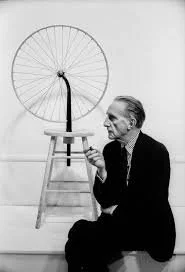
Bicycle Wheel (1913) Marcel Duchamp
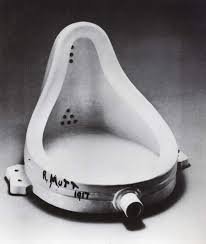
Fountain (1917)
Marcel Duchamp
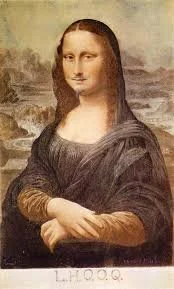
L.H.O.O.Q. (1919) Marcel Duchamp
In Berlin, between 1918 and 1922, Dadaists like Hannah Hoch and Raoul Hausmann used photomontage to attack the German government. By 1924, many members in Paris moved towards the new movement of surrealism, which was influenced by Dadaism. (Richter, 1965).
How and why does Dadaism sound the way it does?
Dadaists purposefully broke existing rules, creating a “non-art” movement that forced audiences to reconsider what it meant to be human, rational, and civilised in a chaotic world. Their approach was characterised by unorthodox and often irrational techniques. They used unconventional sonic and compositional devices to shock, confuse and dismantle traditional aesthetic conventions. In doing so, they embraced absurdity and irrationality to critique the societal logic that led to war. (Mittelmeier, 2016).
To achieve the aesthetic intention of protesting war, nationalism, and social complacency, Dadaists pioneered intentionally unconventional, de-skilled methods including ready-mades, chance operations, photomontage, sound poetry and performance. Key sonic and compositional devices included sound poetry, simultaneous poems, cut-up and randomisation techniques, bruitism, sound collage, automatic compositions, musical ready-mades, performances as anti-art, and intentional dissonance and atonality.
These innovations shifted focus from craftsmanship to artistic intention, democratising and discarding the exclusivity of high-value culture by suggesting that art could be made from anything. They also provoked shock and political critique, reflecting the chaotic post-war European society. (Mittelmeier, 2016).
Hugo Ball
Hugo Ball was a German poet, author, and a leading founder of the Dada movement. In 1915, he moved to Switzerland with his future wife, Emma Hennings, seeking refuge from the turmoil of World War I. He developed “anti-art” to express his rejection of rationalism, nationalism, and conventional language, which he believed led to the war (Ball, 1974).
Ball aimed to renounce what he considered a corrupted form of language, shaped by journalism, propaganda, and patriotism. He sought to create an “innocent” language untouched by convention, referring to it as reaching the ‘innermost alchemy of the world.’ (Ball, 1974). He used irony, spontaneity, and absurdity to challenge traditional artistic norms and social structures.
One of Ball’s most radical inventions was phonetic poetry, a performance without words that abandoned semantic meaning in favour of pure sound. His poem “Karawane” utilised nonsensical sounds to prioritise tone, rhythm, and vocal expression over language (Ball, 1974).
He demonstrated this approach in his “Magical Bishop” performance at the Cabaret Voltaire in June 1916, wearing a rigid costume and a shaman-like toque hat while reciting poems with liturgical intensity, creating a ritualistic and cathartic experience (Richter, 1965).
Ball rejected the idea of absolute originality. Instead, he deconstructed existing materials and rearranged them into new combinations. By 1917, disillusioned with the ‘anarchy’ he had helped unleash, he withdrew from Dada and eventually returned to Catholicism and mysticism (Ball, 1974). His work laid the foundation for surrealism, constructivism, and postmodern art movements.
John Cage
John Cage was a key Neo-Dada figure, translating early twentieth-century European Dadaism into American mid-century avant-garde music and art. His engagement with Dadaist principles began in the late 1940s following World War II, becoming solidified in the early 1950s (Nyman, 1999).
While Ball used Dada to dismantle meaning in language as a protest against war, Cage expanded the concept of meaning in sound, embracing everyday life as a source of music (Richter, 1965). Cage employed chance operations, everyday sounds, and silence to challenge conventional music, reflecting Dadaist principles of anti-art, absurdity, and Marcel Duchamp’s “readymade” concept (Prittchett, 1993).
In his 1952 composition ‘4’33”, performers remain silent, directing the audience’s attention to environmental sounds, demonstrating that all sounds can be understood as music. (Cage, 1961). Cage also embraced indeterminacy, composing works that were incomplete or open-ended, allowing performers to influence the outcome.
Influenced by Duchamp, Zen Buddhism and Asian Philosophies, Cage aimed to dissolve the boundary between “art” and “life,” by removing the artist’s ego and intention so that sound could exist independently (Pritchett, 1993). He also developed the “Prepared piano” (1940), inserting objects like screws, bolts, and rubber between the strings to transform the instrument into a percussive ensemble. (Nyman, 1999).
Through these innovations, Cage broadened the definition of music and challenged audience expectations, laying the foundations for movements such as Fluxus, Minimalism, and conceptual art (Nyman, 1999). Neo-Dadaism declined by 1970 with the emergence of Pop Art (Livingstone, 1990).
Dadaism, which emerged in Hugo Ball’s era as a volatile, nihilistic response to World War I, had evolved by Cage’s post-war period into a calculated and philosophical tool for redefining art. (Neo-Dada) (Cage, 1961).
Lady Gaga
Lady Gaga is considered a modern interpreter of Dadaist principles, using absurd fashion, performance art, and a constructed “monstrous” persona to challenge cultural norms. (Burton, 2013). During her “Art-Pop” era, she merged high art with pop culture, embracing. shock and irony to critique mainstream celebrity culture and media.
By becoming a self-commodifying spectacle, Gaga exposed the absurdity of modern fameand the “bad romance” of mass production, employing nonsensical and surreal fashion (such as the meat dress and lobster headpiece), to reject conventional logic and social standards.
Through her creative team, “Haus of Gaga,” she integrates fashion, music, and visual art into a multidisciplinary spectacle reminiscent of early Dada performances. Her adaptation of “Gagaism” positions her audience as active participants and “performers,” called the “little monsters”, encouraging them to find beauty in imperfection and blurring the line between the idol and fan, particularly within paparazzi culture.
Influenced by Marcel Duchamp’s “readymade” concept, she recontextualises ordinary objects and transforms pop-culture conventions into deliberately exaggerated and conceptually provocative performances, from emerging from a giant egg to staging surreal scenarios.
While original Dadaists sought to reject and dismantle the art system itself (Ball, 1974), Gaga’s work operates within commercial pop structures and mass distribution, illustrating the challenge of sustaining true subversion within a capitalist system. Her connection to Dadaism has been symbolically acknowledged by the directors of the Dadaist Cabaret Voltaire, offering to formally “baptise” her in 2016, recognising her as an heir to the anti-art movement.
Gaga uses Dadaist techniques of shock and absurdity to transform the monstrosity of fame into a tool for questioning contemporary culture, but her work is best understood as a postmodern adaptation of Dadaist principles rather than a direct continuation of the original anti-art ideology, despite being frequently labelled as such in popular media.
Nevertheless, Gaga, along with Ball and Cage, exemplifies a lineage of disruptive artists who use absurdity and spectacle to challenge traditional conventions, tracing Dadaism’s evolution from 1916 through to the present.
Conclusion
Art movements showcase the evolution of creativity from traditional aesthetic standards to modern, conceptual, and multidisciplinary approaches. Art and music have historically evolved together, sharing cultural, emotional, and structural contexts. Studying these connections helps musicians create new movements, break traditions, deepen emotional expression, and develop unique artistic voices.
Dadaism holds a legacy of questioning reality and the definition of art itself and has the potential to evolve into digital absurdism, performative protests, and anti-establishment expressions. It declined after a “big bright explosion” of creative, anti-establishment energy in 1924. However, it was later revived in the form of Neo-Dada in the 1950s by John Cage in America, and what could be considered “Neo-Neo-Dada” in the 2000s through artists like Lady Gaga.
Dadaism fundamentally shifted the art world from a focus on aesthetics and craftsmanship to a focus on ideas and intent.
“I don’t believe in art. I believe in artists.” - Marcel Duchamp.
2
References:
Allington, E. (1980). Aesthetics. Tate.
https://www.tate.org.uk/art/art-terms/a/aesthetics
Auslander, P. (2006). Performance and Celebrity Theory.
Ball, H (1916). “Cabaret Voltaire” Periodical. Julius Heuberger
https://monoskop.org/images/5/52/Ball_Hugo_Cabaret_Voltaire_1916.pdf
Ball, H. (1974, January 1). Flight Out of Time: A Dada Diary. Viking Press.
https://monoskop.org/images/a/a7/Ball_Hugo_Flight_Out_of_Time_A_Dada_Diary_1996.pdf
Brattico, P. and Brattico, A. and Vuust, P. (2017, April 5). Global sensory qualities and aesthetic experience in music. National Library of Medicine.
https://pmc.ncbi.nlm.nih.gov/articles/PMC5380758/
Burton, L. (2013, January 1). Abject appeal and the monstrous feminine in Lady Gaga’s self-fashioned persona, ‘Mother Monster.’ [Griffith University Thesis].
https://research-repository.griffith.edu.au/items/ac68bfb9-df3c-520d-b34f-e2c9aae0f903
Cage, J. & Retallack, J. (1996). Musicage: Cage Muses on Words, Art and Music. Wesleyan University Press.
https://www.weslpress.org/9780819563118/musicage/
Cox, C. & Warner, D. (2017, July 27). Audio Cultures. Bloomsbury Academic.
https://www.bloomsbury.com/au/audio-culture-revised-edition-9781501318368/
Deva, D. (2026, March 18). Why taste might be the most valuable creative skill today. The Drum.
https://www.thedrum.com/industry-insight/why-taste-might-be-the-most-valuable-creative-skill-today
Dickerman, L. and Witkovsky, Mathew S. (2005). The Dada Seminars. National Gallery of Art.
https://monoskop.org/images/a/a1/Dickerman_Leah_Witkowsky_Matthew_S_eds_The_Dada_Seminars_2005.pdf
DiLonardo, A. (2011, September). Lady Gaga and the Other: Persona, Art and Monstrosity. OCAD University. [Essay]
https://openresearch.ocadu.ca/id/eprint/167/1/ADRIANNA%20MRP.pdf
Gariff, D. (2021, August 25). Dada and Surrealism. National Gallery of Art. [Video]
https://www.youtube.com/watch?v=HqDXk_-LFG8
Holsworth, M. (2016, April 17). Dada 1916.
https://melbourneartcritic.wordpress.com/2016/04/17/dada-1916
Hume, D. (1757). Of the Standard Taste [Essay].
https://davidhume.org/texts/empl1/st
Huelsenbeck, R. (1991, June 6). Memoirs of a Dada Drummer. University of California Press.
https://monoskop.org/images/e/e5/Huelsenbeck_Richard_Memoirs_of_a_Dada_Drummer_1974.pdf
Huelsenbeck, R. (1997, August 15). The Dada Almanac. Atlas Press.
Jesus, D. S. V. (2013). Far From Shallow, Lady Gaga’s Hypermodern Revolution. David Publishing.
https://www.davidpublisher.com/Public/uploads/Contribute/60dea67745db4.pdf
Kant, I. (1790/1987): Critique of Judgement. (Pluhar, S. W. Trans.). Hackett Publishing.
https://monoskop.org/images/7/77/Kant_Immanuel_Critique_of_Judgment_1987.pdf
Kedmey, K. (2017, November 3). 100 Years On, Why Dada Still Matters.
https://www.artsy.net/article/artsy-editorial-100-years-on-why-dada-still-matters
Lange, R. (2004, February 14). What is Dadaism in Art?
https://www.robertlangestudios.com/blogs/news/what-is-dadaism-in-art
Livingstone, M. (1990, October). Pop Art: A Continuing History. Thames & Hudson.
https://cir.nii.ac.jp/crid/1971712334835382730
Marie, A. (2025, January 16). Dadaism is Art and Poetry. [Video]
https://www.youtube.com/watch?v=_Ly6X0JgTeo
Mittelmeier, M. (2016, January 25). DADA: Eine Jahrundertgeschichte [Dada: A Century of History]. Sieder Verlag.
Murphett, J. (2022, November). John Cage and 4’33”
Neuendorf, H. (2016, February 5). 100 Years Ago Today, Dada Was Born at Cabaret Voltaire in Zurich.
https://news.artnet.com/art-world/dada-100-year-anniversary-420473
Nyman, M. (1999, October). Experimental Music: Cage and beyond. Cambridge University Press.
https://is.muni.cz/el/phil/jaro2015/IM027/um/Michael.Nyman.Experimental.Music.pdf
Pritchett, J. (1993, November 25). The Music of John Cage. Cambridge University Press.
Rasula, J. (2015, June 2). Destruction Was My Beatrice: Dada and the Unmaking of the Twentieth Century. Basic Books & Hachette Group.
Richter (1965, 1997, April 2nd Republication). Dada: Art and Anti-Art. Thames & Hudson.
https://monoskop.org/images/4/41/Richter_Hans_Dada_Art_and_Anti-Art_1997.pdf
Schopenhauer, A. & Payne, E. F. J. (1818). The World as Will and Representation. Cambridge University Press. https://www.cambridge.org/core/books/schopenhauer-the-world-as-will-and-representation/6AA41648D7C79FD5C01EDFBA37B9FBD2
Scruton, R. (1999, June 3). Aesthetics in Music. Clarendon Press.
https://docdrop.org/pdf/Scruton-1999-The-Aesthetics-of-Music-h0dqk.pdf/
The Art Story (2017, May 17). Hugo Ball Performances, Bio, Ideas.
https://www.theartstory.org/artist/ball-hugo/
The Art Story (2012, November 21). Neo-Dada Movement Overview.
https://www.theartstory.org/movement/neo-dada
Trachtman, P. (2006, May). A Brief History of Dada.
https://www.smithsonianmag.com/arts-culture/dada-115169154/
Tzara, T. (1917, July). Dada Journal [Publication].
https://monoskop.org/Dada_(journal)
Watts, A. H. (1979). Chance: A Perspective on Dada. UMI Research Press.
https://search.library.uq.edu.au/discovery/fulldisplay/alma991008982829703131/61UQ_INST:61UQ
Wilete, J. (2012, January 27). Neo-Dada
